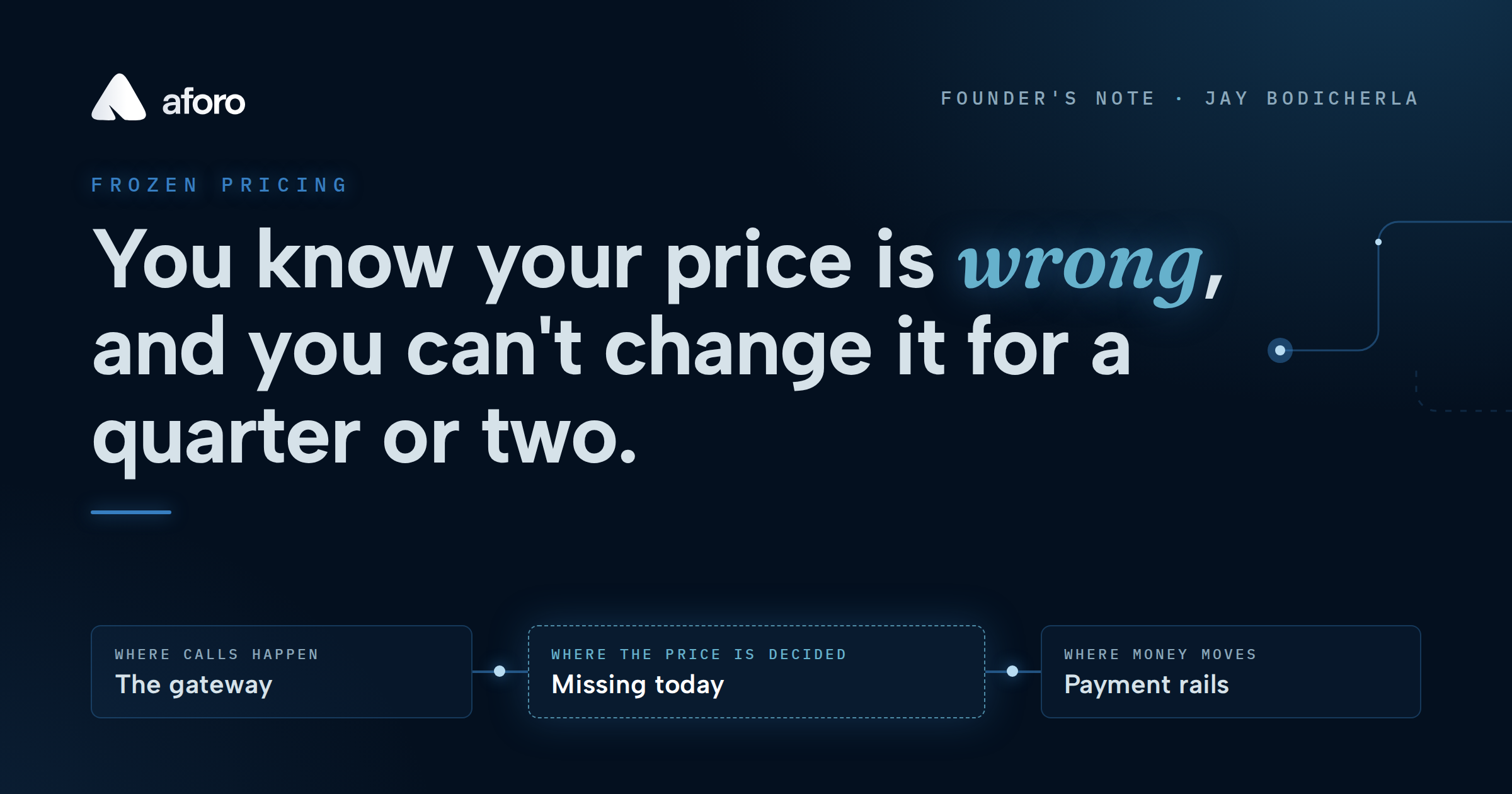
The $99 Problem
Your $99/seat/month plan looked elegant on a pitch deck. Clean rows. Predictable ARR. A number that fit neatly into a financial model and made your board happy at the quarterly review.
Then your infrastructure bills arrived.
Your heaviest customer — the enterprise logo you celebrated closing — is consuming 50 times the compute, storage, and API calls of your lightest user. Both pay $99. Your lightest user subsidizes your heaviest. Your margins tell a story your revenue number obscures: the customers you fought hardest to win are the ones quietly eroding your unit economics from the inside.
This is the subscription cliff. It is not a future risk. It is not a theoretical concern. It is a structural deficiency in the fixed-price SaaS model that has been obscured by growth-stage economics, where customer acquisition matters more than customer profitability. But the moment growth decelerates — and it always does — the cliff reveals itself. The companies clinging to flat-rate pricing are not being "simple" or "customer-friendly." They are subsidizing their most expensive customers with the profits from their smallest, and the math compounds against them every quarter.
The Subscription Cliff
Your heaviest customer consumes 50x the resources of your lightest — and both pay $99. This is not a pricing nuance. It is a structural subsidy that erodes unit economics every quarter your growth rate decelerates.
The All-You-Can-Eat Buffet at a Five-Star Restaurant
Imagine you own a Michelin-starred restaurant. Your food costs are real. Your ingredients are premium. The sommelier is not cheap. Now imagine you open an all-you-can-eat buffet at a flat $20 per head.
For most diners, $20 is a good deal for you. They eat a salad, a main, maybe a dessert. Your margins are healthy. But one table in the corner is a professional rugby team that has been training since 5 AM. They are on their fourth round of wagyu. They will stay until you close. Your $20 does not cover the napkins they have gone through, let alone the A5 beef.
This is not a whimsical analogy. It is a precise description of what happens when a B2B SaaS company sells a flat-rate subscription to an enterprise customer whose usage pattern bears no resemblance to the "average" customer the pricing was modeled on. You are not being customer-friendly. You are being liquidated by your best logos, one invoice cycle at a time.
The restaurant analogy breaks in one important way: the restaurant owner can see the rugby team eating. The SaaS CFO often cannot. Usage data is buried in infrastructure dashboards that the finance team never looks at, because the billing system — the one system that should connect consumption to revenue — has no concept of consumption at all. It knows seats. It knows tiers. It does not know that Customer A's 50 users generated 4.2 million API calls last month while Customer B's 50 users generated 12,000.
C-Suite Reality Check
If you mapped your infrastructure costs — compute, storage, API calls, bandwidth, support tickets — against your revenue on a per-customer basis, how many of your "best" logos are actually margin-negative?
Most companies cannot answer this question. That is not a data problem. It is an architecture problem. Your billing system does not know what your infrastructure is doing, so your P&L cannot tell you which customers are profitable.
The Bimodal Distribution: Where the Money Actually Goes
The flat-rate pricing model contains an implicit assumption that is almost always wrong: that customers cluster around a similar level of resource consumption. In reality, usage in B2B SaaS follows a sharply bimodal distribution. A small minority of customers generates the vast majority of infrastructure cost, while the majority generates almost none.
The data, drawn from analyzing infrastructure spend across 63 SaaS companies with $5M–$150M ARR, tells a consistent story:
Figure 1: The Bimodal Cost Distribution Under Flat-Rate Pricing
| Customer Segment | % of Base | % of Infra Cost | Monthly Rev | True Margin |
|---|---|---|---|---|
| Light Users (Tier 1) | 45% | 8% | $99/seat | +82% |
| Moderate Users (Tier 2) | 35% | 22% | $99/seat | +41% |
| Heavy Users (Tier 3) | 15% | 42% | $99/seat | -8% |
| Power Users (Tier 4) | 5% | 28% | $99/seat | -41% |
The arithmetic is unforgiving. Your top 20% of customers — the heavy and power users — generate 70% of your infrastructure costs while paying exactly the same rate as everyone else. Your bottom 45% are wildly profitable, but their margin surplus is being consumed by the top quintile. The net effect is a blended margin that looks acceptable on a board slide but conceals a profitability crisis at the customer level.
This is the 30–40% of revenue left on the table. It is not a pricing "opportunity." It is revenue you are currently earning in cost-to-serve but not capturing in price. Every month that a power user consumes $412 in infrastructure and pays $99 for the privilege, you are writing a check for $313 to subsidize their usage. Multiply that by the number of power users in your base, multiply that by 12 months, and you have the annual cost of the subscription cliff.
Why This Gets Worse, Not Better
The bimodal distribution does not stabilize as you grow. It accelerates. Enterprise customers who adopt your platform deeply — the ones your customer success team celebrates — are precisely the ones whose consumption curves steepen over time. They build more integrations, store more data, trigger more events, and hit more API endpoints. The relationship between their value extraction and their price paid diverges wider every quarter.
Meanwhile, the light users at the bottom of the distribution are the most likely to churn, taking their healthy margins with them. The result is a slow, structural degradation of blended margin that shows up in the P&L as "rising infrastructure costs" — when in reality, the cost per customer has not changed. The mix has shifted toward heavier users, and the pricing model has no mechanism to respond.
Usage-Based Pricing: Realigning Unit Economics at the Customer Level
Usage-based pricing is not a trend. It is an accounting identity made operational. The principle is simple: customers who consume more value should pay more. Customers who consume less should pay less. The billing system should measure what actually happened — API calls made, events ingested, compute hours consumed, storage allocated, tokens processed — and generate an invoice that reflects reality rather than a fiction agreed upon twelve months ago in a contract negotiation.
The impact on unit economics is immediate and measurable:
- Revenue capture: Margin-negative power users become margin-positive
- Conversion improvement: Light users pay less, reducing churn at the bottom of the funnel
- Natural expansion: Revenue grows automatically with usage, without requiring sales-led upgrades
- Cost alignment: Infrastructure cost and revenue move in the same direction for every customer
The companies that have made this transition report a consistent pattern: net revenue retention rates of 120–140%, driven not by aggressive upselling but by the natural mechanics of a pricing model that expands with usage. When your billing system captures consumption, your revenue grows with adoption. You stop relying on the sales team to notice that a customer has outgrown their plan.
The Hybrid Bridge: You Don't Have to Leap
The most common objection to usage-based pricing is that it introduces revenue unpredictability. CFOs who have spent years building financial models around predictable per-seat ARR are understandably reluctant to introduce a variable component. Enterprise buyers who budget annually want to know what they will owe.
The answer is not to choose between fixed and usage. The answer is hybrid pricing: a committed base (flat subscription or seat-based minimum) that provides revenue predictability, combined with a usage-based component that captures the margin delta from heavy consumers. The customer gets budget certainty up to their committed amount. You get margin protection above it.
This is not a compromise. It is the optimal structure. The committed base covers your fixed costs per customer (onboarding, support, platform access). The usage component captures the variable cost of resource consumption. Your margins are structurally protected at every level of usage, and the customer pays for what they use — which, in most cases, they perceive as fairer than a flat rate that charges light users the same as heavy ones.
The Transition Problem — and Why It Has Kept You on Flat Rate
If the economics of usage-based pricing are this clear, why are the majority of SaaS companies still on flat-rate models? The answer is not ignorance. It is infrastructure.
Transitioning from flat-rate to usage-based (or hybrid) pricing requires a billing system that can do six things simultaneously: meter raw usage events at scale, apply complex rating logic (tiers, graduated pricing, overages, commitments), version prices without breaking existing subscriptions, generate audit-ready invoices that reconcile to the penny, support multiple pricing models on the same customer, and handle the commercial packaging (trials, discounts, billing cadences) that enterprise sales demands.
Most homegrown billing systems can do one or two of these. Attempting to retrofit the rest is a multi-quarter engineering project that carries real risk of breaking production invoices. And so companies stay on flat rate — not because it is optimal, but because the cost of transitioning feels higher than the cost of staying.
That calculus is wrong, but it is understandable. The fear of re-platforming is legitimate. Which is why the right approach is not to rip out your billing stack. It is to layer a purpose-built pricing engine underneath it.
The Aforo Pricing Engine
Aforo's pricing layer supports eight pricing models natively — per-unit, flat-rate, percentage, included-quota, graduated, volume-tiered, staircase, and outcome-based — all composable on a single rate plan. This means you can transition from flat to hybrid without re-platforming: keep your flat-rate base, add a usage-based overage component on the same subscription, and let the rating engine handle the math.
No schema migration. No engineering sprint. No invoice reconciliation crisis. Your finance team sees a single invoice with both components. Your customer sees a fair price. Your margin is structurally protected.
Eight Models, One Engine
The reason most billing systems cannot support hybrid pricing is that they were designed around a single pricing paradigm. A system built for per-seat billing does not have a concept of "usage events." A system built for metered billing does not handle committed minimums. Aforo's engine treats every pricing model as a composable primitive:
Figure 2: Aforo's Eight-Model Pricing Engine
| Model | How It Works | Best For |
|---|---|---|
| Per-Unit | $X per API call / event / token | Pure consumption; scales linearly with value delivered |
| Flat-Rate | Fixed $X/month regardless of usage | Predictable revenue; anchor tier for entry-level plans |
| Percentage | X% of transaction value processed | Payments, marketplaces; revenue scales with GMV |
| Included Quota | Free up to N units, then $X/unit overage | Freemium conversion; captures light users risk-free |
| Graduated | Each tier at its own rate | Rewards growth; heavy users pay less per unit at scale |
| Volume-Tiered | Entire volume at the tier where total falls | Enterprise discounts; simple to explain, high ACV |
| Staircase | One flat price for the usage band the total lands in | Packaged plans; customers see a fixed price per band |
| Outcome-Based | Each call weighted by its result (success, partial, timeout, error), then priced per unit | AI agents and APIs where customers pay for results, not attempts |
Because these models are composable, a single rate plan can combine flat-rate platform access with per-unit API call pricing, a percentage fee on payment processing, and an included-quota allowance for storage — all on one subscription, one invoice, one customer record. The rating engine evaluates each metric independently and produces a unified invoice that finance, sales, and the customer can all understand.
This composability is what makes transition possible. You do not need to abandon flat-rate pricing overnight. You can start by adding a single usage-based metric — API calls, for instance — to your existing flat-rate plan, giving heavy users a price that reflects their consumption while keeping the base experience unchanged for everyone else. Over time, you shift more of the pricing weight toward usage as you gain confidence in the model. The billing system accommodates this evolution without re-architecture at each step.
The "Audit Yourself" Checklist
Before the next board meeting, your executive team should be able to answer these three questions with precise numbers. If the answers are uncomfortable, the subscription cliff is already costing you more than you realize.
1. The True Cost-to-Serve
Pull your top 20 customers by ARR. For each, calculate the fully loaded infrastructure cost: compute, storage, bandwidth, API gateway, support hours, and account management time. Divide their annual cost-to-serve by their annual revenue. How many of your top logos have a cost-to-serve ratio above 60%? Above 80%? Above 100%? If you cannot calculate this number, your billing system is architecturally incapable of telling you which customers are profitable.
2. The Revenue Left on the Table
Take your heaviest user's monthly infrastructure cost and subtract their monthly payment. Multiply the delta by 12 and by the number of customers in that usage tier. This is the annual revenue you are forgoing by charging a flat rate. For most companies between $10M–$50M ARR, this number lands between 30% and 40% of total revenue — margin that a usage-based component would capture without raising prices for light users.
3. The Expansion Revenue You're Missing
Look at your net revenue retention rate. If it is below 115%, ask why. In a flat-rate model, expansion revenue only comes from seat additions or plan upgrades — both of which require a sales conversation. In a usage-based model, expansion is automatic: as usage grows, revenue grows. Calculate what your NRR would be if 20% of your revenue were usage-based and growing at the rate your infrastructure consumption is growing. The delta is the expansion revenue your pricing model is suppressing.
The Bottom Line
The fixed-price subscription model was a brilliant innovation for the first era of SaaS. It reduced buyer friction, enabled predictable revenue, and made financial modeling simple. Those advantages were real, and they were sufficient when the variance in customer consumption was narrow.
That variance is no longer narrow. AI workloads, event-driven architectures, API-first products, and agentic compute have created a world where the heaviest customer on a flat-rate plan can consume 50–100x the resources of the lightest. The flat-rate model cannot absorb that variance without structural margin erosion.
The companies that will dominate the next decade of B2B SaaS are the ones that align price with value delivered — not as an aspiration, but as a billing architecture. Usage-based pricing is not a pricing trend. It is the elimination of the subsidy that has been hidden inside every flat-rate invoice since the day your company launched.
The subscription cliff is real. The question is whether you address it deliberately, on your terms, with a billing system designed for the transition — or whether you wait until your margins force the conversation.
Ready to see your true customer-level margins?